Sarah Mullally Appointed as Incoming Spiritual Leader of Canterbury
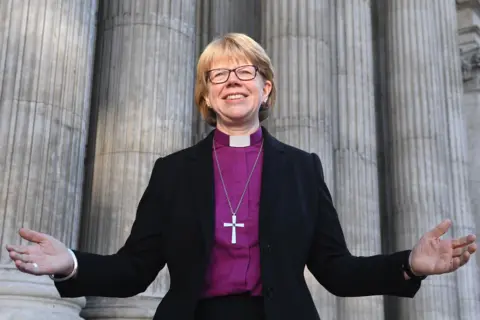
Dame Sarah Mullally has been selected as the incoming spiritual leader of the Church of England - making history as the first woman to be chosen for this prestigious role.
A former NHS chief nurse, the sixty-three-year-old entered the priesthood in 2006 and was appointed as the first female Bishop of London in 2018 - the third most senior member of clergy in the Church of England.
This represents the first time in nearly 500 years of tradition that the Church has nominated a female to assume its leadership.
Historic Selection
The Anglican Church has been without someone in the leading position for approximately twelve months after Justin Welby resigned over a safeguarding scandal.
He stepped down following a critical investigation into a prolific child abuser associated with the Church. The investigation found that he "was able and obligated" have reported the misconduct by John Smyth of boys and young men to police in 2013.
The Archbishop of York assumed most of Mr Welby's duties in an interim move, and was one of the voting members of the committee charged with selecting his successor.
Official Procedure
Following established custom, the process of selecting a new archbishop involves a candidate being presented to Prime Minister Sir Keir Starmer and then forwarded to the monarch.
Sir Keir has applauded the selection of Dame Sarah, commenting: "The Archbishop of Canterbury will play a key role in our national life. I offer my best wishes and anticipate working together."
While, technically, the King is head of the Church of England, the individual occupying the role of spiritual leader is the most senior bishop and is the religious guide of the religious institution and the worldwide Anglican Communion.
Royal and International Response
King Charles III has congratulated the new Archbishop on her appointment, "a position of great significance in the United Kingdom and across the global Anglican Communion", the royal household stated.
The Global Fellowship of Confessing Anglicans, which represents conservative views, has criticised the appointment, stating that although some will welcome it, "the majority of the global church still believes that the Bible requires a male-only episcopacy."
Transition Period
She does not legally take on her position until a confirmation of election in January, and an enthronement service comes subsequently, after they have paid homage to the monarch.
In a declaration on the announcement day after her appointment was finalized, she commented: "I recognize this is a huge responsibility but I approach it with a sense of peace and faith in divine guidance to carry me as has consistently occurred."
Addressing media at the historic church, she noted that "in an age that craves certainty and tribalism, the Anglican tradition provides a more subtle approach but stronger."
Addressing Violence
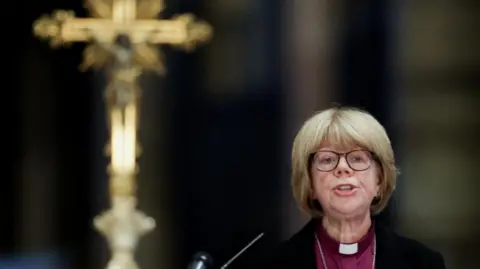
Addressing the "terrible attack" of the previous day's incident on a synagogue in the northern city, she said "we observe hatred that emerges through fractures across our society."
She added: "We then as a Church have a responsibility to be a group who stand with the Jewish community against antisemitism in all its forms. Prejudice and discrimination of all types cannot be allowed to divide our society."
Background and Career
Married with two children, she spent over 35 years in the NHS, achieving the position of the most junior person to serve as chief nurse for the country in 1999.
Although she was volunteering in the religious community at the period, it was just a few years later that she chose to enter a clergy member and was promptly assigned helping implement changes in the way the institution dealt with misconduct.
In that year she became canon treasurer at the historic church before assuming the role of Bishop of Crediton in the regional church administration in 2015.
As London's religious leader she was regarded as someone who used her experience as an NHS administrator to help update the church district.
Guiding Principles
"People frequently inquire what it has been like to have had two careers, first in the health service and currently in the religious institution.
"I like to consider that I have consistently maintained one vocation: to pursue Christian faith, to know him and to make him known, always seeking to demonstrate empathy in the service of others, whether as a nurse, a priest, or a bishop."
Upcoming Responsibilities
Possibly the pressing issue in her in-tray is still to develop improved approaches towards addressing misconduct and approaching with greater empathy those impacted by such incidents.
There has also been a decline in religious participation, though London has to a degree bucked that trend.
One of the areas she has been particularly vocal on is end-of-life choices - she is a strong critic, as was her preceding Archbishop.
When the law was passed in the Commons, she described it as "impractical and dangerous and creates danger to the most vulnerable people in our society."
Modern Positions
Among her responsibilities as London's religious leader was to lead a committee trying to guide the Church's decision on whether to sanction gay unions.
She described the decision to finally allow clergy to bless same-sex couples in last year as "a moment of hope for the Church."
A former Archbishop, summarised her position as necessitating a "newspaper in one hand and a Bible in the other."
Dr Williams explained to media outlets "the expectation of having an position on all matters is significantly demanding."